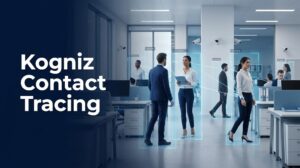
Kogniz contact tracing is an AI-assisted workplace safety solution designed to help organizations identify interpersonal exposure and understand how people move and interact inside physical environments. Rather than asking employees to remember every person they met during a potentially risky period, the technology can use computer vision, surveillance infrastructure, and dedicated wearable devices to create a more structured picture of workplace interactions.
The technology is associated with the broader Kogniz AssureAI workplace safety platform. Kogniz has positioned AssureAI as a computer-vision and AI-driven system for detecting and managing workplace safety events. Its contact-tracing capabilities emerged prominently during the COVID-19 period, when organizations needed faster ways to identify possible exposure without depending entirely on manual interviews and handwritten records.
Today, the most useful way to understand Kogniz Contact Tracing is not simply as a COVID-era tool. It is better viewed as a technology approach for digitally recording proximity and interaction information in physical workplaces. However, organizations should distinguish between capabilities documented by Kogniz and older or third-party descriptions that may no longer represent the current configuration.
What Is Kogniz Contact Tracing?
Kogniz Contact Tracing is designed to help workplace safety teams determine which people may have been exposed to an individual during a defined period. The basic idea is straightforward: if an employee is identified as having a potentially contagious illness, an organization needs to know where that person went and which other people they encountered.
Traditional contact tracing depends heavily on interviews. A worker may be asked where they went, who they spoke with, where they ate lunch, which meetings they attended, and how long they spent with particular colleagues. Human memory can be incomplete, especially when the investigation covers several days.
Kogniz approaches the problem with technology. Depending on the deployment, the system can use existing surveillance cameras or dedicated contact-tracing wearables and gateways to help reconstruct interactions. The resulting information can give authorized workplace teams a more consistent starting point for an exposure investigation.
How Does Kogniz Contact Tracing Work?
The technology can be understood through two major approaches: camera-based contact tracing and wearable-based contact tracing. These approaches solve a similar problem but collect information in different ways.
With camera-based tracing, computer vision analyzes video from compatible surveillance infrastructure. The objective is to understand the movement of people through monitored areas and identify interactions or proximity events. This approach can be attractive to organizations that already have extensive camera coverage because it can build on infrastructure that is already installed.
The wearable approach uses dedicated devices carried or worn by employees. Kogniz has offered contact-tracing wearables together with a gateway designed to support contact tracing and social-distancing monitoring. The devices provide another source of interaction information, particularly in environments where camera coverage is incomplete.
Camera-Based Contact Tracing
Camera-based Kogniz Contact Tracing uses computer vision to extract useful information from surveillance video. Instead of requiring a safety manager to manually watch hours of recordings, AI-based analysis can help locate relevant people and interactions within the monitored environment.
A typical investigation begins when an organization identifies an employee who may have been exposed to or carrying an infectious illness. An authorized user can then investigate the person’s movements during a specified period. The system’s purpose is to help identify where that person appeared and which other individuals may have been nearby.
This approach is particularly relevant in offices, factories, retail facilities, campuses, warehouses, government buildings, and other locations where surveillance cameras already form part of the security infrastructure.
One important limitation is camera coverage. AI cannot recover information from an area that was never captured adequately. Camera angle, image quality, lighting, occlusion, crowded environments, and changes to the physical layout can all affect what a computer-vision system can determine.
Wearable and Gateway-Based Contact Tracing
Kogniz has also offered dedicated contact-tracing wearables and a Kogniz Contact Tracing Gateway. According to Kogniz’s solution material distributed through Carahsoft, these products are designed for contact tracing and social distancing.
Wearables provide a different model from camera analytics. Instead of relying on visual analysis, employees carry or wear dedicated hardware that can participate in the contact-tracing system. The gateway provides the infrastructure through which those devices can be monitored as part of the solution.
This can be useful in environments where cameras do not provide complete coverage. It can also provide a more direct mechanism for proximity monitoring. Kogniz’s public-sector solution information describes the wearables and gateway as providing employee feedback when social-distancing rules are not followed, along with contact-tracing reports.
The trade-off is that wearable systems depend on user participation. Devices must be distributed, maintained and used correctly. If employees forget to wear a device, remove it, or fail to keep it operational, the resulting contact history can become incomplete.
Kogniz Contact Tracing and Kogniz AssureAI
Kogniz Contact Tracing is not best understood as an isolated product. It fits within the wider Kogniz AssureAI ecosystem, which is designed around AI-powered workplace safety and security.
Kogniz describes AssureAI as a platform combining computer vision, incident management and AI-driven insights. Public descriptions of the platform include use cases such as occupational safety, workplace violence prevention, evacuation management, personnel accountability and health-related controls.
During the COVID-19 period, the broader Kogniz health platform included functions such as contact exposure detection, social-distancing monitoring, temperature screening and mask detection. This positioned contact tracing as one component of a larger workplace health and safety strategy rather than a standalone application.
That distinction matters because an organization may not be looking only for contact tracing. A company could instead be evaluating whether one workplace safety platform can support several operational requirements at the same time.
Key Features of Kogniz Contact Tracing
The most important capabilities can be summarized by looking at what each part of the system is intended to accomplish.
| Feature | What it is designed to do | Main benefit |
|---|---|---|
| Computer vision | Analyze compatible surveillance footage for people and interactions | Reduces manual video review |
| Contact-tracing reports | Help reconstruct relevant interactions and movements | Speeds exposure investigations |
| Wearables | Provide proximity information through dedicated devices | Extends tracing beyond camera coverage |
| Contact Tracing Gateway | Connects wearable-based monitoring infrastructure | Supports centralized contact monitoring |
| Social-distancing feedback | Detects proximity conditions in supported deployments | Provides immediate awareness |
| AssureAI integration | Places contact tracing within a wider safety platform | Creates a broader workplace safety ecosystem |
| Existing camera infrastructure | Uses compatible surveillance environments | Can reduce the need for entirely new camera deployments |
These features should not be interpreted as a guarantee that every deployment includes every capability. Kogniz solutions can vary according to the environment, hardware, configuration, and implementation requirements.
What Happens During an Exposure Investigation?
A useful way to understand Kogniz Contact Tracing is to follow the investigation from beginning to end.
First, an organization identifies a person who requires an exposure review. This could happen because of an illness report or another internal health and safety procedure. The organization then defines the relevant time period for the investigation.
Next, the available technology is used to reconstruct the person’s movements and interactions. In a camera-based deployment, computer vision can analyze relevant surveillance footage. In a wearable deployment, the system can use recorded proximity information from the participating devices.
The resulting information can then be reviewed by authorized personnel. Instead of treating the technology as a medical diagnosis system, it should be viewed as an information-gathering tool. The organization still needs appropriate workplace health procedures and qualified decision-makers to determine what action should follow.
This distinction is important. Contact-tracing software can help answer “Who may have been exposed?” It does not independently determine whether someone has an infectious disease.
Can Kogniz Contact Tracing Use Existing Security Cameras?
Yes, this is one of the central ideas behind the camera-based approach.
Kogniz has described its workplace safety platform as being capable of working with existing surveillance infrastructure. Its public-sector solution material also describes Kogniz Cortex as introducing the AssureAI platform to IP cameras.
The advantage is straightforward. Many large organizations already operate extensive security-camera networks. If compatible cameras can be used instead of installing an entirely separate camera network, the organization may have a simpler infrastructure path.
However, “uses existing cameras” does not mean every existing camera will automatically produce perfect results. The quality of contact tracing still depends on factors such as coverage, positioning, resolution, lighting and the physical environment.
For this reason, a responsible deployment should begin with a camera-coverage assessment rather than assuming that every part of a facility can be traced equally well.
Kogniz Contact Tracing Wearables and the Gateway
The wearable system addresses a different technical challenge.
A large factory, warehouse, distribution center or other facility may contain areas where cameras cannot reliably capture every interaction. Employees can move behind equipment, around corners, through temporary work zones, or into locations with limited surveillance coverage.
Dedicated wearables can provide an alternative source of proximity information. The gateway serves as part of the supporting infrastructure for these devices.
Kogniz’s public solution information specifically describes the contact-tracing wearables and gateway as supporting contact tracing and social distancing. It also describes immediate employee feedback when social-distancing requirements are not followed.
The wearable approach therefore has an important practical advantage: it does not depend entirely on the visual field of a camera. Its main operational challenge is participation and device management.
Does Kogniz Contact Tracing Track People in Real Time?
The answer depends on which technology and configuration an organization uses.
Kogniz has described real-time capabilities across parts of its computer-vision workplace safety platform, and its contact-tracing materials describe immediate feedback and contact-tracing reporting.
However, “real-time” should not automatically be interpreted as a perfect live map of every person inside a facility. Different components have different functions. A camera system may analyze video streams, while wearable systems collect proximity information through dedicated hardware.
The most accurate description is that Kogniz is designed to automate the collection and analysis of relevant workplace interaction information, with real-time monitoring and feedback available in supported configurations.
Kogniz Contact Tracing and Social Distancing
Contact tracing and social-distancing monitoring are closely related but are not identical.
Contact tracing looks backward or across a defined period to understand who interacted with whom. Social-distancing monitoring focuses more directly on whether people are currently positioned too close together according to configured rules.
Kogniz has offered technologies for both purposes. Its public-sector material describes a Kogniz Distance Camera for social-distancing monitoring and the Contact Tracing Wearables and Gateway for contact tracing and social distancing.
This creates an important distinction for organizations. A workplace may use proximity alerts to encourage safer behavior before an exposure occurs, while contact tracing can help investigate interactions after a potential exposure has already been identified.
Other Kogniz AssureAI Safety Capabilities
One reason organizations may evaluate Kogniz as a platform rather than a single-purpose tool is the broader range of workplace safety functions associated with AssureAI.
Public descriptions of the platform include computer-vision use cases such as PPE detection, occupancy monitoring, person counting, physical security, workplace violence detection, evacuation management and personnel accountability.
Kogniz’s earlier health platform also combined several pandemic-era capabilities, including contact exposure detection, mask detection, social-distancing enforcement and temperature monitoring.
This broader ecosystem can matter when a company wants to avoid managing several unrelated systems. Instead of treating contact tracing as a separate project, it can potentially form part of a wider workplace safety architecture.
Kogniz Contact Tracing Integrations
Enterprise software rarely operates alone. Workplace safety information may need to connect with human resources, communication, access-control, reporting or operational systems.
Current software-directory listings for Kogniz identify integrations including ServiceNow, Slack, Workday HCM, Microsoft Power BI, Tableau, Snowflake, Cisco Meraki, Samsung SDS and Axis.
These integrations are particularly relevant for larger organizations because safety incidents often involve several departments. HR may manage employee information, facilities may manage buildings, security may manage cameras, and safety teams may investigate incidents.
However, an integration listing should not be interpreted as proof that every contact-tracing workflow automatically works with every listed system. Organizations should confirm the exact integration, supported data flows and current configuration during implementation.
How Quickly Can Kogniz Be Deployed?
Kogniz historically emphasized rapid deployment. During the 2020 launch of its health platform, the company stated that its minimal-hardware design and flexible configurations could allow many organizations to install and begin using the platform in ten minutes or less.
That claim should be placed in its historical context.
A software or hardware component may be quick to install, but enterprise deployment is usually more complicated. Organizations may still need to configure cameras, map facilities, establish permissions, define retention policies, train staff, test reporting, connect other systems and obtain internal approvals.
Therefore, a better expectation is that the technology can be designed for rapid technical deployment, while a complete organizational rollout may require substantially more planning.
Industries That Can Use Kogniz Contact Tracing
The technology is most relevant to organizations where people regularly share physical environments.
Manufacturing facilities can benefit from systems that help understand employee interactions across production areas. Warehouses and distribution centers may have large teams working across defined zones. Retail organizations can have employees and visitors moving through multiple areas. Government facilities, campuses and other large sites may also have extensive physical footprints where manual tracing becomes difficult.
The value is greatest when the organization already has suitable infrastructure or when the operational cost of manually reconstructing interactions is high.
Benefits of Kogniz Contact Tracing
The primary benefit is speed. Manual contact tracing can require interviews, memory-based reconstruction and lengthy video searches. Automation can reduce the amount of repetitive work involved in finding relevant information.
A second benefit is consistency. A digital record can provide a more structured account of movements and proximity events than relying solely on human recollection.
A third benefit is scalability. Large workplaces can contain hundreds or thousands of people. A technology-assisted approach can help safety teams investigate larger environments without manually watching every minute of every camera feed.
Another advantage is flexibility. Organizations can potentially choose between camera-based and wearable-based approaches depending on their physical environment.
Finally, contact tracing can become part of a broader safety strategy when it is deployed alongside other AssureAI capabilities.
Limitations of Kogniz Contact Tracing
No contact-tracing technology can eliminate uncertainty.
Camera-based tracing is limited by what cameras can actually see. Blind spots, poor lighting, blocked views and insufficient camera coverage can reduce the usefulness of the resulting information.
Wearable tracing has a different limitation: participation. The system depends on employees carrying or wearing the relevant devices correctly and consistently.
There is also a privacy consideration. A system capable of reconstructing workplace movements and interactions handles sensitive employee-related information. Organizations need clear rules governing who can access the data, why it is collected, how long it is retained and under what circumstances it can be reviewed.
Finally, technology does not replace professional judgment. A contact report should support a workplace health and safety process rather than automatically determine medical or employment decisions.
Privacy and Workplace Monitoring Considerations
Privacy is one of the most important topics that receives too little attention in discussions about Kogniz Contact Tracing.
The technology can involve information about people’s movements, proximity and workplace interactions. That means organizations should establish governance before deployment rather than treating privacy as an afterthought.
A sensible implementation should define the purpose of collection, restrict access to authorized personnel, establish appropriate retention periods and communicate the system’s purpose clearly to employees.
Organizations should also consider applicable privacy, employment and workplace-monitoring requirements in their jurisdiction. The exact legal obligations can differ significantly between countries, states and industries.
Most importantly, organizations should avoid collecting more information than they genuinely need. A clear purpose makes it easier to determine what data should be retained and who should be allowed to see it.
Is Kogniz Contact Tracing Still Relevant After COVID-19?
The technology became strongly associated with COVID-19, but the underlying problem is broader.
Workplaces can experience outbreaks of many infectious illnesses. The exact public-health response depends on the disease, jurisdiction and circumstances, but organizations can still face operational challenges when they need to determine who may have shared a space with an affected employee.
The modern relevance of Kogniz Contact Tracing therefore comes less from the COVID-19 label and more from the general concept of using automation to understand physical workplace interactions.
That said, organizations should evaluate whether they actually need contact tracing and whether the expected benefit justifies the privacy, hardware, infrastructure and operational requirements.
What Competitor Articles Often Get Wrong or Leave Out
Many articles about Kogniz Contact Tracing repeat the same basic explanation: AI monitors people, identifies contacts and improves workplace safety. That description is useful, but incomplete.
One missing issue is the difference between technology capability and verified current deployment. Older material often describes the product during the 2020 COVID-19 response, while newer pages may add claims that are not clearly supported by current first-party documentation.
Another overlooked issue is the importance of camera coverage. A system cannot trace what its sensors or cameras cannot observe.
The wearable model also deserves more attention. Wearables can solve camera blind spots, but they introduce their own operational requirements, including distribution, maintenance and employee participation.
Finally, privacy should not be reduced to a simple statement that a system is “secure.” Workplace monitoring involves governance questions as well as cybersecurity questions. Organizations need policies that explain what information is collected and how it will be used.
These distinctions provide a more realistic picture of what Kogniz Contact Tracing can and cannot do.
Kogniz Contact Tracing vs. Manual Contact Tracing
The biggest difference between the two approaches is how information is collected.
Manual tracing depends heavily on interviews, employee memory, written notes and human review of available records. It can work, but the process can become slow when many people or locations are involved.
Kogniz introduces automated data collection and analysis into that process. Cameras or wearables can provide structured information that safety teams can investigate more quickly.
| Factor | Manual Contact Tracing | Kogniz Contact Tracing |
|---|---|---|
| Primary data source | Interviews and records | Cameras, wearables and supporting systems |
| Investigation speed | Often slower | Designed to automate parts of investigation |
| Human workload | High | Reduced for supported automated tasks |
| Camera dependency | Optional | Important for camera-based deployment |
| Wearable dependency | None | Required for wearable-based deployment |
| Coverage | Depends on memory and records | Depends on sensor/camera coverage |
| Privacy considerations | Employee information | Employee movement/proximity information |
| Best use | Smaller or less complex investigations | Large physical environments with suitable infrastructure |
Neither method should be viewed as universally superior. Technology is most valuable when the physical environment and operational requirements make automated tracing practical.
What Should Organizations Evaluate Before Deployment?
Before purchasing or deploying a contact-tracing system, organizations should begin with the problem rather than the technology.
First, determine why contact tracing is needed and what decisions the resulting information will support. If the objective is unclear, collecting large amounts of movement data may create unnecessary complexity.
Next, evaluate the physical environment. Identify where cameras exist, where coverage is weak, where employees work, and whether wearable devices would be practical.
The organization should then establish privacy and governance rules. Define authorized users, data retention, access procedures and employee communication before the system goes live.
Integration requirements should also be reviewed. If the organization already uses HR, workplace-management, communication or analytics systems, determine exactly which data needs to move between platforms.
Finally, test the system in a limited environment. A pilot can reveal coverage problems, operational issues and false assumptions before a full-scale rollout.
Common Questions About Kogniz Contact Tracing
What is Kogniz Contact Tracing used for?
Kogniz Contact Tracing is designed to help organizations identify workplace interactions and potential exposure events using technologies such as computer vision and dedicated contact-tracing hardware.
Does Kogniz Contact Tracing require cameras?
Not necessarily. Kogniz has offered both camera-based capabilities and wearable/gateway-based contact-tracing solutions. The appropriate approach depends on the organization’s environment and deployment configuration.
Can Kogniz use existing security cameras?
Kogniz has designed parts of its workplace safety platform to work with existing surveillance infrastructure and IP cameras. However, suitability depends on the specific camera environment and configuration.
What is the Kogniz Contact Tracing Gateway?
The Kogniz Contact Tracing Gateway is hardware associated with Kogniz’s wearable-based contact-tracing solution. It supports the infrastructure used to monitor interactions and social-distancing conditions.
Does Kogniz Contact Tracing diagnose illness?
No. Contact-tracing technology is designed to provide information about interactions or potential exposure. It should not be confused with medical diagnosis or disease testing.
Is Kogniz Contact Tracing only for COVID-19?
The technology became prominent during the COVID-19 pandemic, but the underlying concept of identifying workplace exposure can apply more broadly to infectious-disease response. Actual use should follow applicable health guidance.
Can Kogniz Contact Tracing work in a factory or warehouse?
It can be relevant to these environments, particularly where organizations need to understand interactions across large physical facilities. Camera coverage, wearable deployment and site layout should be evaluated before implementation.
Does Kogniz offer integrations with workplace software?
Current software-directory listings identify integrations including ServiceNow, Slack, Workday HCM, Microsoft Power BI, Tableau, Snowflake, Cisco Meraki, Samsung SDS and Axis. Exact contact-tracing workflows should be confirmed with the vendor.
Is Kogniz Contact Tracing expensive?
Publicly available software-directory information does not provide a universal current price for Kogniz. Enterprise pricing can depend on software, hardware, facility size, configuration and implementation requirements.
Is employee privacy a concern?
Yes. Any technology capable of tracking workplace movements or interactions raises privacy and governance questions. Organizations should establish clear access, retention, purpose and communication policies before deployment.
Final Verdict on Kogniz Contact Tracing
Kogniz Contact Tracing represents an important shift from manual workplace exposure investigations toward automated, technology-assisted tracing. Its approach combines AI and computer vision with existing surveillance infrastructure, while its wearable and gateway solution provides another option for monitoring proximity.
The biggest strength is not simply that the system can collect information. It is the potential to turn scattered workplace data into a structured picture that safety teams can investigate more quickly.
At the same time, organizations should avoid treating Kogniz Contact Tracing as a magic solution. Camera coverage, wearable participation, data governance, privacy, integrations and operational procedures all affect the usefulness of the technology.
For organizations considering the platform today, the best approach is to evaluate the exact deployment configuration rather than relying on generic descriptions. Confirm which capabilities are currently offered, what hardware is required, which cameras are supported, how information is handled, what integrations are available and how the solution fits the organization’s existing workplace safety procedures.
Used thoughtfully, Kogniz Contact Tracing can serve as one component of a broader workplace safety strategy. Its greatest value comes when automated technology supports — rather than replaces — responsible human decision-making.